Hydraulics & Pumps
VFDs on Pumps and Fans: Affinity Laws and Energy-Saving Calculation
Why a 20 % speed reduction can cut power by almost half, and how to calculate real savings.
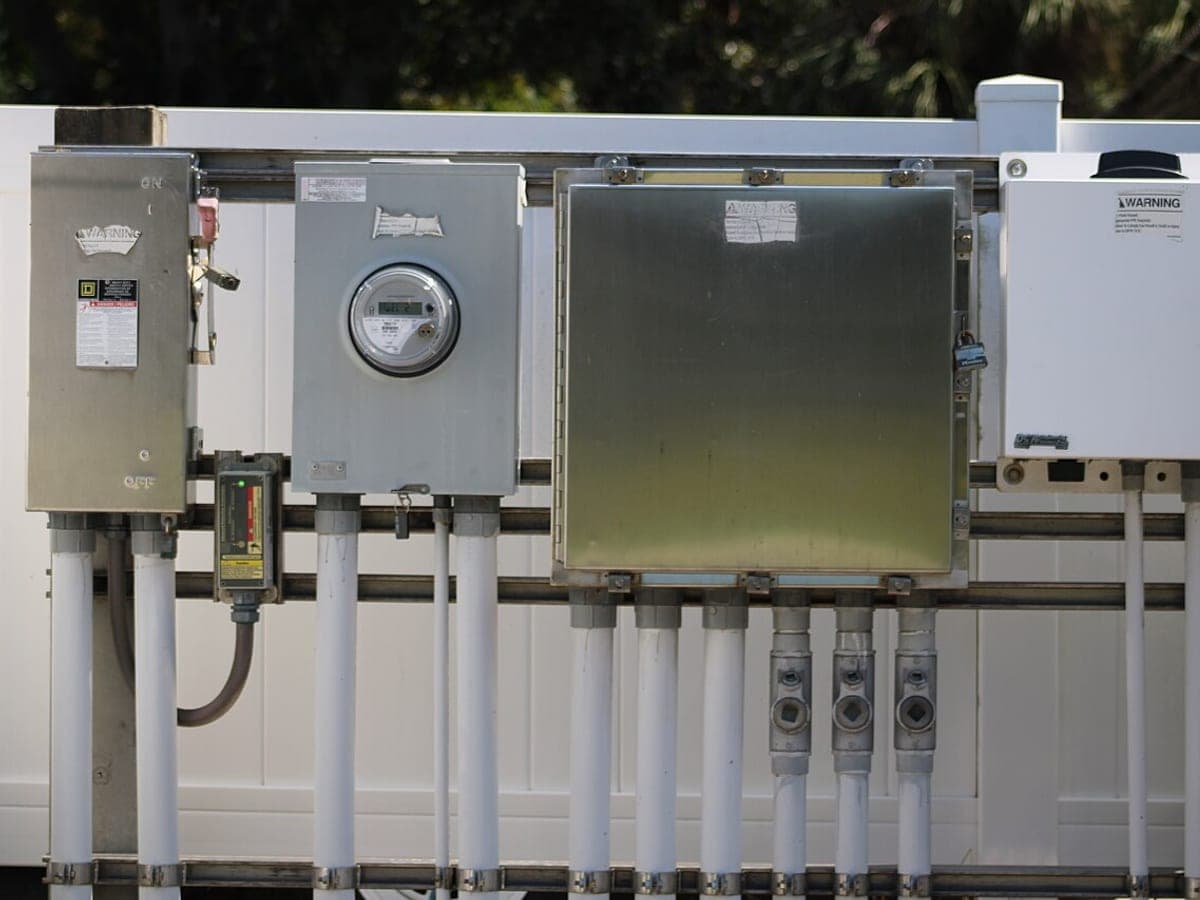
Photo: Philipp Michel Reichold · CC BY-SA 4.0 · Image credits
The affinity laws
| Quantity | Relation to speed | At 80 % speed |
|---|---|---|
| Flow Q | Q ∝ N | 80 % |
| Head H | H ∝ N² | 64 % |
| Power P | P ∝ N³ | 51 % |
Power varies with the cube of speed, so a small speed reduction produces a large energy saving. Throttling a valve, in contrast, merely adds pressure drop and wastes energy across the valve.
Worked savings example
Example
A 30 kW pump running 6000 h/year at 70 % average flow: ≈ 25 kW with a throttle valve and ≈ 12.4 kW with a VFD. Saving ≈ 12.6 kW, or about 76 MWh per year (≈ 6057 USD at 0.08 USD/kWh).
When a VFD is not suitable
- Pumps with very high static head (over 60 %): savings shrink and speed must not fall below a minimum.
- Loads that are nearly constant and always close to rated.
- Old motors with weak insulation and no dv/dt filter.
Installation tip
Set a minimum speed for motor cooling and seal lubrication (usually 30–40 %) and program skip frequencies to avoid resonance.
Related articles

Steam Trap Selection Guide: Types, Principles and Common Mistakes
Why one failed trap can waste thousands of dollars of steam a year, and how to choose the right trap.
2 min read
Control Valve Sizing: Flow Coefficients Cv and Kv in Practice
From the basic formula to selecting size and trim characteristic, with a worked example and a Kvs table.
2 min read
PID Controller Tuning: Fundamentals, Methods and Step Response
The effect of each parameter, Ziegler–Nichols and lambda tuning, with a simulated first-order-plus-dead-time process.
1 min read