Control Valve Sizing: Flow Coefficients Cv and Kv in Practice
From the basic formula to selecting size and trim characteristic, with a worked example and a Kvs table.
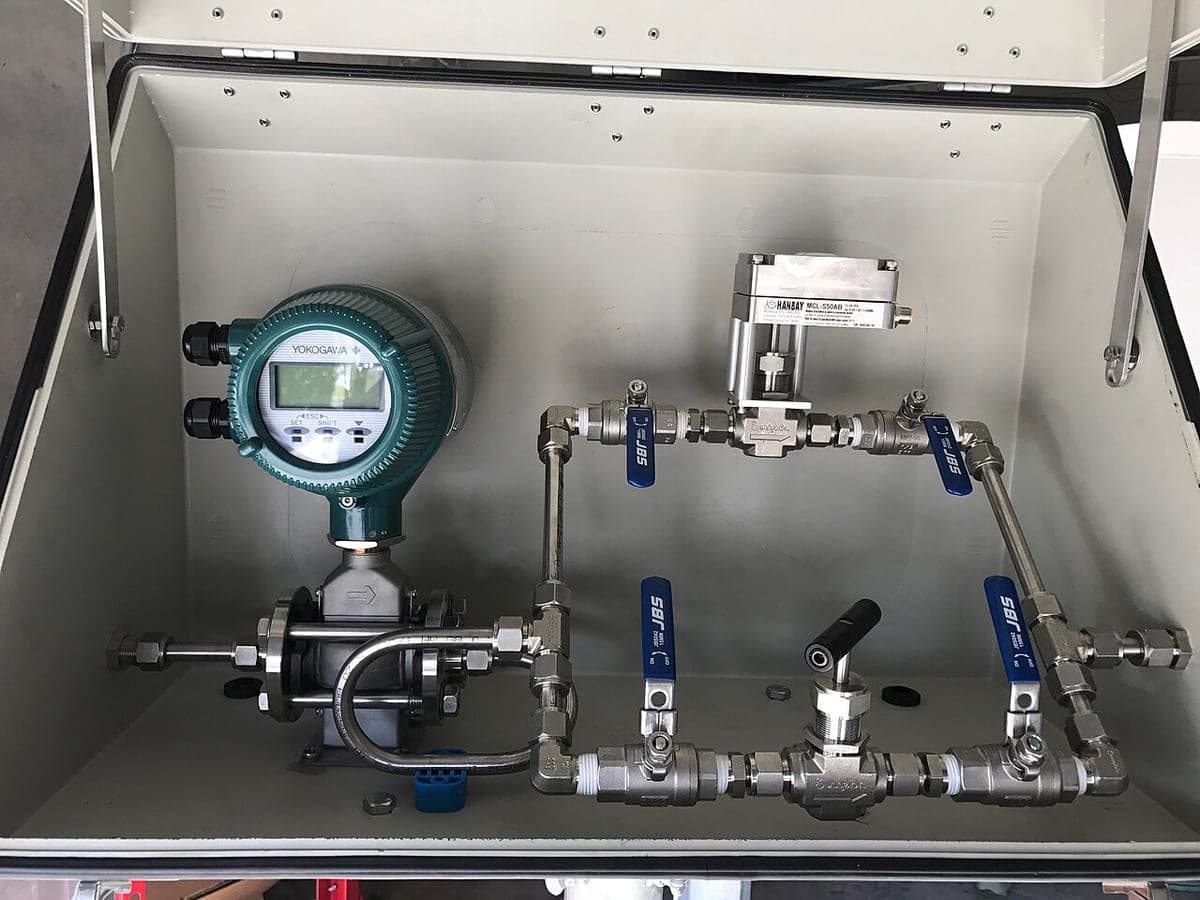
Photo: Ie edits · CC BY-SA 4.0 · Image credits
Why valve size matters
An oversized control valve spends most of its time almost closed and makes regulation unstable; an undersized one cannot pass peak flow. The goal is roughly 50–70 % open at normal flow.
The basic liquid equation
Kv = Q · √(SG / ΔP) Cv = 1.156 · Kv
Here Q is volumetric flow in m³/h, ΔP is the pressure drop across the valve in bar and SG is the specific gravity. Kv is the flow of 20 °C water in m³/h at 1 bar pressure drop.
Worked example
Water at 40 m³/h with 1 bar allowable drop: Kv = 40·√(1/1) = 40 and Cv ≈ 46. With a 20 % margin the required Kv is 48, so choose the next higher Kvs (63, DN65).
| Nominal size | Standard Kvs (m³/h) | Equivalent Cv |
|---|---|---|
| DN15 | 4 | 4.6 |
| DN20 | 6.3 | 7.3 |
| DN25 | 10 | 11.6 |
| DN32 | 16 | 18.5 |
| DN40 | 25 | 28.9 |
| DN50 | 40 | 46.2 |
| DN65 | 63 | 72.8 |
| DN80 | 100 | 115.6 |
| DN100 | 160 | 185 |
Trim characteristic: linear or equal-percentage?
- Linear: flow proportional to travel; suits near-constant valve drop (level control, flow with a fixed pump).
- Equal-percentage: each percent of travel changes flow by a constant percentage; for temperature and pressure loops where the drop varies with flow.
- Quick opening: for on/off and safety duty.
Valve authority
Authority β is the valve's fully-open pressure drop divided by the total circuit drop. Below 0.3 the installed characteristic departs from the inherent one and control degrades; 0.3–0.5 is recommended.
Warning
Gas and steam use a different equation and must be checked for choked flow and the expansion factor Y. Never apply the liquid formula to steam.
Related articles
Steam Trap Selection Guide: Types, Principles and Common Mistakes
Why one failed trap can waste thousands of dollars of steam a year, and how to choose the right trap.
2 min read
PID Controller Tuning: Fundamentals, Methods and Step Response
The effect of each parameter, Ziegler–Nichols and lambda tuning, with a simulated first-order-plus-dead-time process.
1 min read
The 4–20 mA Current Loop: Principles, Wiring and Troubleshooting
Why it has been the industrial signal standard for over half a century, and how to design it properly.
2 min read