PID Controller Tuning: Fundamentals, Methods and Step Response
The effect of each parameter, Ziegler–Nichols and lambda tuning, with a simulated first-order-plus-dead-time process.
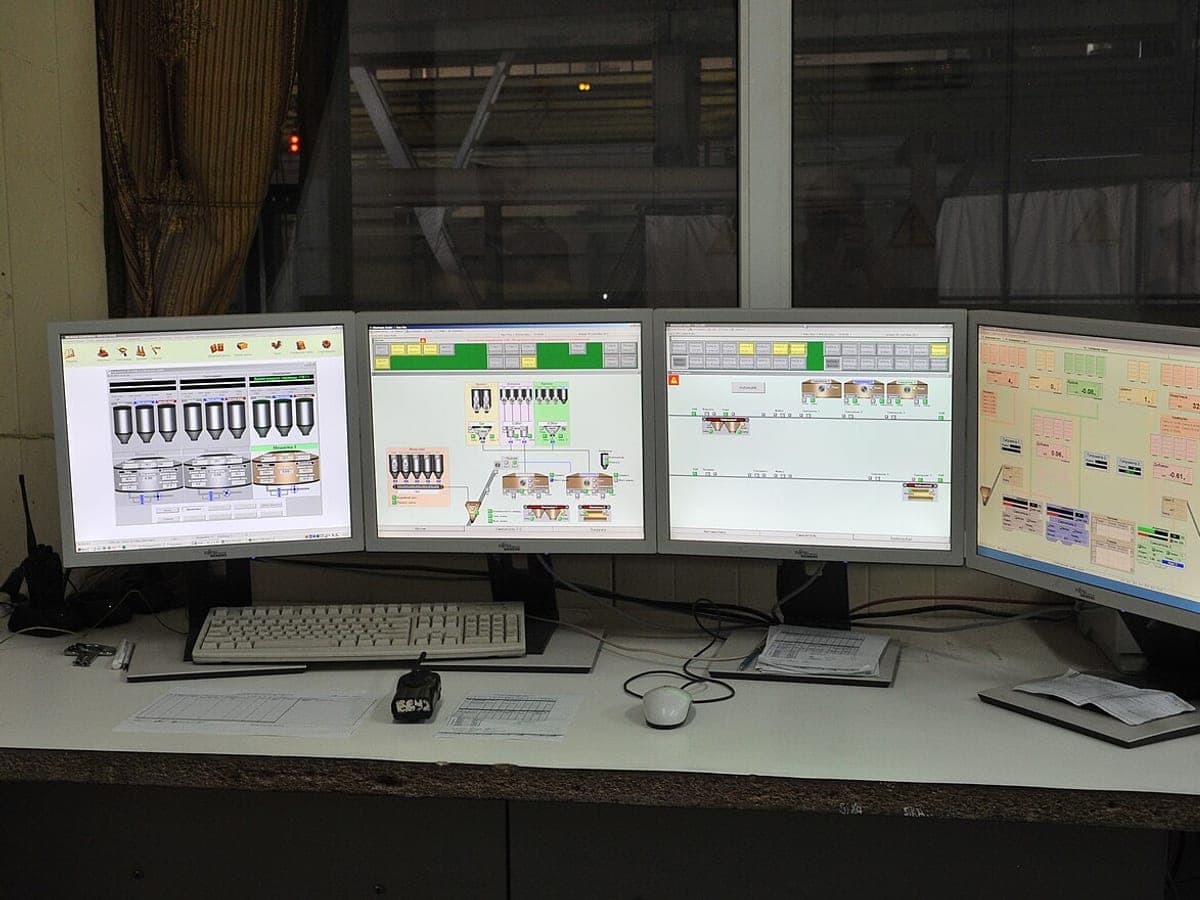
Photo: Tdmzgbi · CC BY-SA 4.0 · Image credits
What is PID?
A PID controller combines three terms acting on the error between setpoint and measurement: proportional (P) reacts to the present error, integral (I) to the accumulated past error and derivative (D) to the rate of change.
u(t) = Kp · [ e(t) + (1/Ti) ∫ e dt + Td · de/dt ]
Effect of increasing each parameter
| Parameter | Rise time | Overshoot | Settling time | Steady-state error |
|---|---|---|---|---|
| Kp | Decreases | Increases | Small change | Decreases |
| Ki | Decreases | Increases | Increases | Eliminated |
| Kd | Small change | Decreases | Decreases | No change |
Ziegler–Nichols reaction-curve method
From an open-loop step test you obtain process gain K, time constant τ and dead time θ, and the parameters follow from the table below.
| Controller | Kp | Ti | Td |
|---|---|---|---|
| P | τ / (K·θ) | — | — |
| PI | 0.9·τ / (K·θ) | 3.33·θ | — |
| PID | 1.2·τ / (K·θ) | 2·θ | 0.5·θ |
Lambda (IMC) tuning
You choose the desired closed-loop time constant λ and set Kp = τ / (K·(λ+θ)) and Ti = τ. Typically λ is 1–3 times θ; larger values give a slower, more robust response.
Rule of thumb
Fast flow and pressure loops usually need only PI — leave D out. D helps only on slow processes like temperature with long dead time, and it amplifies noise.
Related articles

Steam Trap Selection Guide: Types, Principles and Common Mistakes
Why one failed trap can waste thousands of dollars of steam a year, and how to choose the right trap.
2 min read
Control Valve Sizing: Flow Coefficients Cv and Kv in Practice
From the basic formula to selecting size and trim characteristic, with a worked example and a Kvs table.
2 min read
The 4–20 mA Current Loop: Principles, Wiring and Troubleshooting
Why it has been the industrial signal standard for over half a century, and how to design it properly.
2 min read