Pipe Pressure Drop: the Darcy–Weisbach Equation and Pipe Sizing
Calculating water pressure drop in steel pipes, recommended velocities and how diameter affects pumping energy cost.
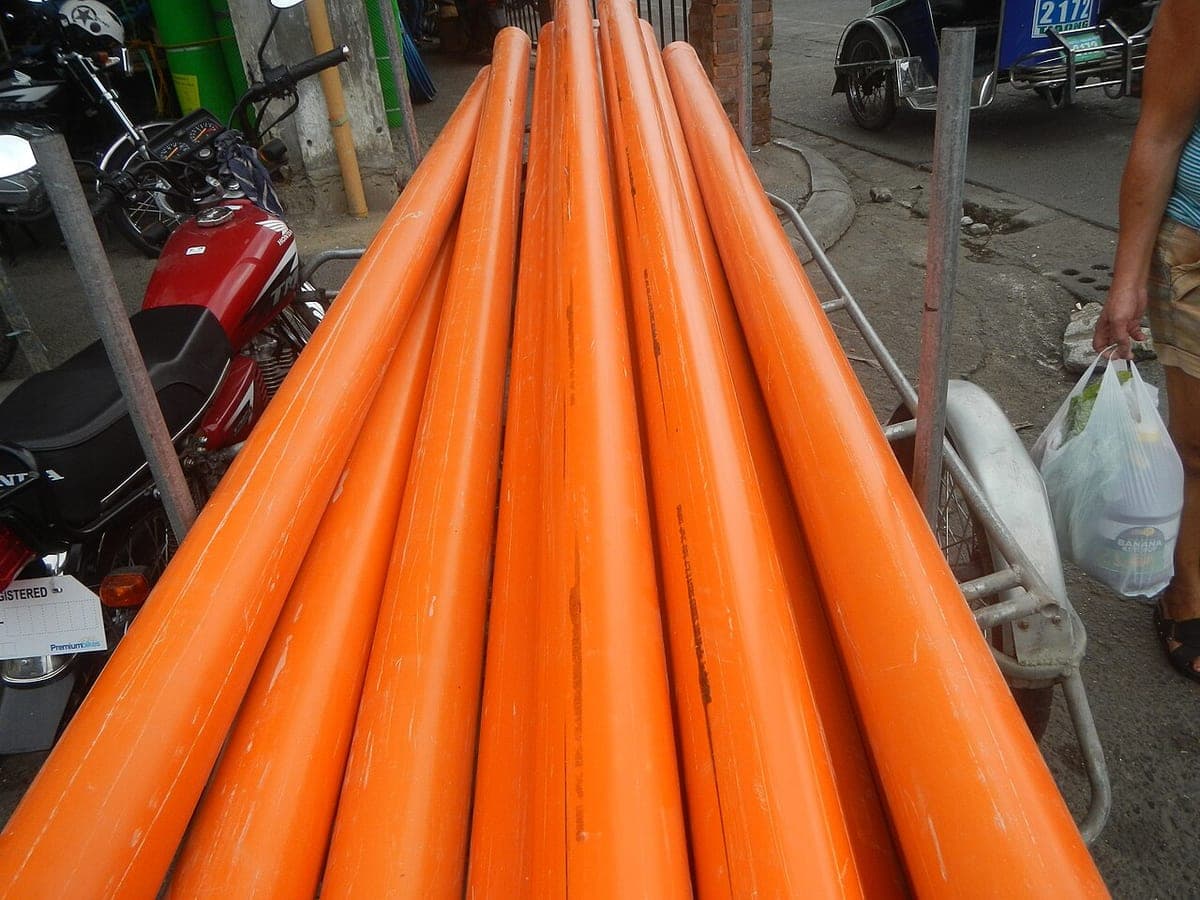
Photo: Judgefloro · CC0 · Image credits
The Darcy–Weisbach equation
ΔP = f · (L / D) · (ρ · v² / 2)
f is the Darcy friction factor, L the pipe length, D the inner diameter, ρ the density and v the mean velocity. For turbulent flow f follows from the Swamee–Jain relation using Reynolds number and relative roughness:
f = 0.25 / [ log₁₀( ε/(3.7·D) + 5.74/Re^0.9 ) ]²
Pressure-drop chart
Example
For 12 m³/h of water in DN50 (53 mm inner diameter): velocity ≈ 1.51 m/s and pressure drop ≈ 48 kPa per 100 m.
Recommended velocities
| Service | Velocity (m/s) | Consideration |
|---|---|---|
| Pump suction | 0.5 – 1.5 | Avoid cavitation |
| Pump discharge | 1.5 – 3.0 | Balance cost and energy |
| Building chilled / hot water | 0.9 – 2.0 | Limit noise and erosion |
| Saturated steam | 20 – 40 | Pressure drop and noise |
| Condensate | 1 – 2 | Two-phase on return |
Bigger pipe or more energy?
Pumping power is proportional to pressure drop, and pressure drop falls roughly with the fifth power of diameter. A larger pipe size adds a little purchase cost but saves significant energy over the system's life. Use life-cycle cost (LCC) to decide.
Related articles
Steam Trap Selection Guide: Types, Principles and Common Mistakes
Why one failed trap can waste thousands of dollars of steam a year, and how to choose the right trap.
2 min read
Control Valve Sizing: Flow Coefficients Cv and Kv in Practice
From the basic formula to selecting size and trim characteristic, with a worked example and a Kvs table.
2 min read
PID Controller Tuning: Fundamentals, Methods and Step Response
The effect of each parameter, Ziegler–Nichols and lambda tuning, with a simulated first-order-plus-dead-time process.
1 min read